
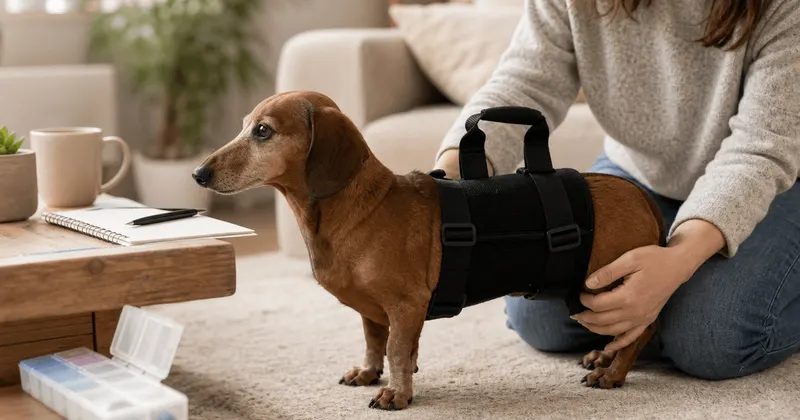
How Common Is IVDD in Corgis? Risk, Signs, and What To Do
IVDD in Corgis is not a rare freak accident. Pembroke and Cardigan Welsh Corgis are chondrodystrophic dogs: the same FGF4-related short-leg biology that makes the silhouette cute also ages the discs early. If you searched how common is IVDD in Corgis, you want a prevalence answer, not a generic "see your vet."
This article is written for that query. It is not a substitute for a neurologist. It is the briefing owners wish they had before the first yelp on the stairs.
How common is it, really?
Exact lifetime percentages vary by study, clinic, and whether you count only surgical cases or every sore back. What does not vary: - Corgis belong to the high-risk chondrodystrophic group with Dachshunds, Beagles, Bassett Hounds, and other FGF4-retrogene breeds. - In Dachshunds, published lifetime IVDD estimates often land in a roughly 15-25% band depending on the paper and population. Corgis share the disc morphology that drives Hansen Type I extrusion (a sudden, toothpaste-like burst of nucleus into the spinal canal). - Mixed-breed, long-legged dogs have a much lower baseline. Comparing a Corgi to a Labrador is the wrong comparison. Compare a Corgi to other short-legged herding and hunting breeds.
So the honest 2026 answer: IVDD is one of the signature orthopedic-neurologic diseases of the Corgi. It is common enough that breed clubs talk about ramps the way Golden Retriever clubs talk about hips. It is not "every Corgi will be paralyzed." It is "you should set the house up as if a disc could go, because in this breed it might."
Our clinical brief at IVDD in Corgis is the structured medical page. This post is the prevalence and "what happens this weekend" guide.
Why Corgi discs fail
Chondrodystrophy changes cartilage. Discs dehydrate and mineralize years earlier than in non-chondrodystrophic dogs. A jump off the sofa, a twist after a squirrel, or no obvious trauma at all can extrude disc material and bruise the spinal cord.
Hansen Type I in Corgis tends to be acute. Owners describe: - A yelp when picked up under the ribs - A hunched back (kyphosis) - Shivering, panting, or refusing food because of pain - Knuckling, dragging nails, or a drunken rear gait - In the worst hours: inability to stand, and loss of bladder control
Pain-only IVDD and paralysis IVDD are the same disease at different neurologic grades. Grade can change in a night. That is why "wait until Monday" is a dangerous plan if the dog cannot walk.
Grades owners can actually use
Neurologists use slightly different scales. This is the household version:
- Pain only, still walking normally
- Wobbly (ataxia) but can walk
- Cannot walk, still has pain sensation in the toes
- Cannot walk, pain sensation reduced or gone
- Paralysis with loss of deep pain (the emergency surgical clock)
Deep pain is not "does he cry when I touch his back." It is a specific toe pinch assessed by a veterinarian. Do not test this at home in a way that makes the dog panic or thrash.
What to do in the first two hours - Stop jumping. Carry the dog like a lasagna tray, spine supported, not hanging from the armpits. - Call an emergency clinic with neurology or surgery capability if walking is gone or pain is explosive. - Do not give human ibuprofen or acetaminophen. - Photograph the last time the dog urinated. Bladder care becomes the make-or-break aftercare item. - Open a note with timestamps: when the yelp happened, whether they walked after, whether the tail wags, whether they can feel the floor.
If you already keep records in one vault, add the video of the gait. Neurologists would rather see a 12-second hallway walk than a vague "he's off."
Medical vs surgical
Crate rest (typically weeks, not days) plus pain control can work for lower grades when the dog is still walking and imaging or exam supports it. Compliance is the treatment. "Crate rest except when he looks sad" is how discs re-explode.
Decompression surgery is on the table when the dog cannot walk, when pain is uncontrollable, or when imaging shows a compressive extrusion. Cost varies wildly by city and whether MRI is included, often in the thousands to low tens of thousands. Ask for an itemized estimate: MRI, surgery, hospitalization, bladder care, rehab.
Prognosis tracks neurologic grade and how fast you moved, not how cute the Instagram ramp was after the fact.
Home setup that actually reduces risk - Ramps to sofa and bed. Corgis will jump if the furniture is their identity. - No stairs unsupervised during a flare. - Harness, not a neck-only leash, if your vet agrees. - Weight: extra kilos are extra disc load. Keep a weekly weight in the same health tracker you use for meds. - Flooring: rugs on hardwood so rear feet can grip.
Ramps do not make IVDD rare. They make the stupid jump less likely.
What to keep in the medical file
Neurology is a document sport: - MRI or CT date and the segment (T11-T12, L2-L3, etc.) - Surgical report if there was surgery - Crate-rest start and end dates - Bladder expression schedule - NSAID and gabapentin doses with the prescribing clinic - Recheck neuro exams
That file is how a second clinic, a rehab tech, or a sitter avoids restarting the injury. Use a share folder for pets so the neurologist and the regular vet see the same PDFs.
FAQ
How common is IVDD in Corgis?
Common relative to the average dog. Corgis are a high-risk chondrodystrophic breed. Treat spinal care as a core Corgi topic, not a trivia fact.
Are Cardigans safer than Pembrokes?
Both are chondrodystrophic. Do not pick a variety to dodge IVDD.
Is IVDD in Corgis genetic?
The short-leg architecture is genetic. Not every Corgi extrudes a disc. Breeding conversations belong with a veterinarian and the breed club health statement, not a forum poll.
Can they recover without surgery?
Many walking dogs do, with strict rest. Non-walking dogs need same-day veterinary triage.
Should I use a back brace I saw online?
Only if your veterinarian or rehab clinician fitted it. Random Amazon braces can change gait in the wrong way.
Bottom line
IVDD in Corgis is common enough to plan for. Ramps, weight, and a dated symptom log are cheaper than MRI. If the rear end goes down, move like it is an emergency, because in this breed it often is.